20 June, 2026
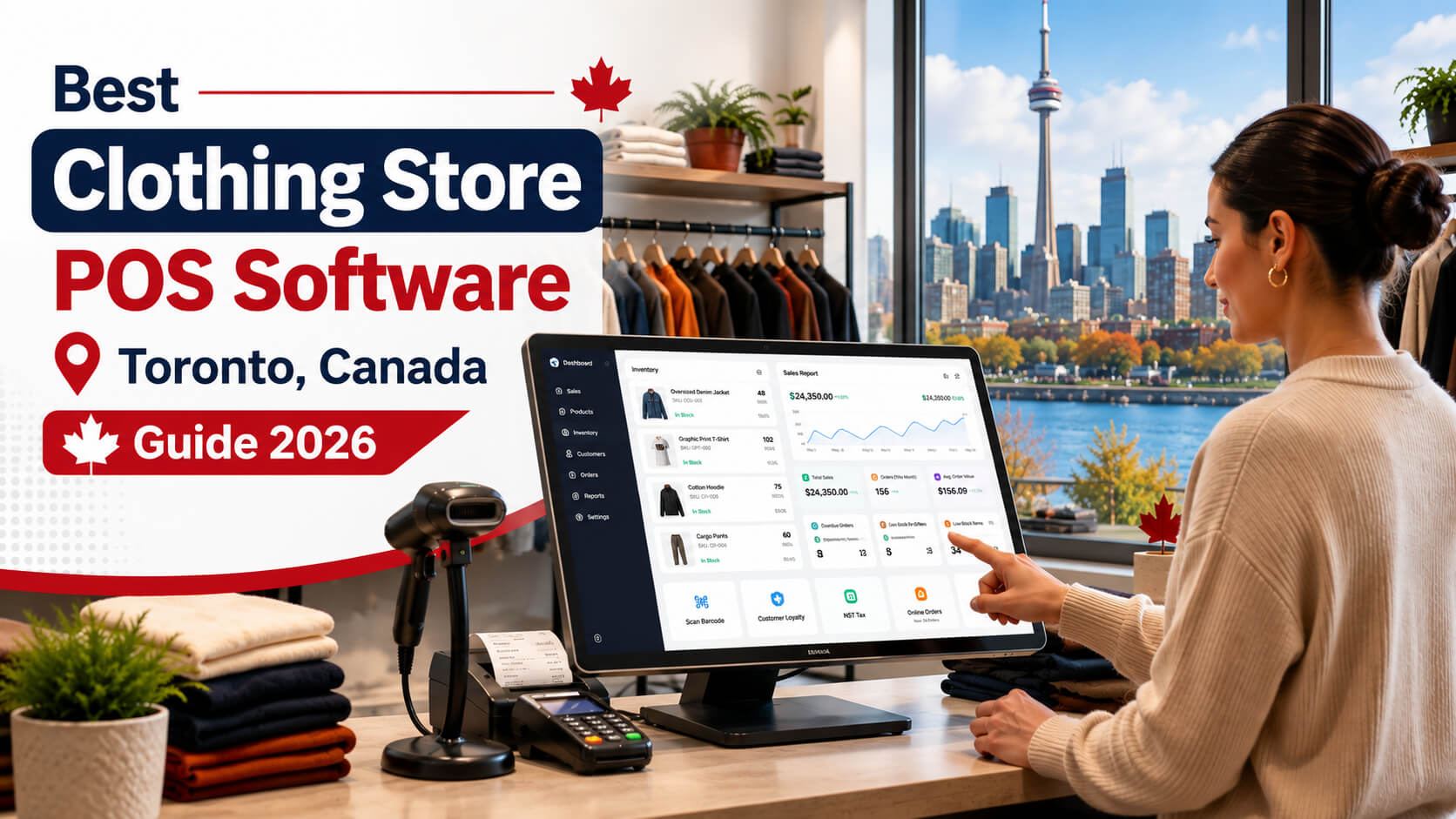
Best Clothing Store POS Software Toronto Canada Guide 2026
Looking for the best POS software for your Toronto clothing store? This guide covers the top options for managing sales, inventory, customer loyalty, and online orders in 2026.
Running a clothing store in Toronto is exciting, but it is also demanding. Between seasonal collections, Boxing Day promotions, back-to-school sales, online orders, HST, returns, exchanges, and customer loyalty, many retailers quickly outgrow basic cash registers or generic POS tools. That is why choosing the right clothing store POS Software Toronto businesses can rely on is no longer just a technology decision. It is an operations decision.
In neighbourhoods like Scarborough, North York, Etobicoke, Queen West, and the Danforth, fashion retailers deal with fast-moving inventory, multiple sizes, colour variations, and customers who expect the same smooth experience they get from larger Canadian brands like Canadian Tire or Shopify-powered stores. At SK Soft Solutions Inc., based in Scarborough, Toronto, we help Canadian SMEs modernise retail operations with custom POS software, ERP integration, e-commerce, mobile apps, SEO, and digital marketing. This guide explains what clothing store POS software should include, how much it costs in Canada, and how Toronto retailers can choose the best system for long-term growth. The best clothing store POS software in Toronto should manage inventory, sizes, colours, barcodes, HST, returns, loyalty, staff access, and online sales in one system. For Canadian retailers, a custom POS built with local tax, privacy, and retail workflows in mind can be more flexible than generic software. Clothing store POS software is a retail management system that helps fashion retailers process sales, manage inventory, track products by size and colour, handle returns, apply taxes, manage staff permissions, and understand daily performance. For a Toronto clothing store, a POS system should do more than accept payments. It should help the owner know which jackets sold in Scarborough, which sizes are running low in Mississauga, which collection performed best during Black Friday, and which customers are likely to return for Boxing Day promotions. A good apparel POS system usually includes: In Canada, retail software also needs to respect local business realities. That includes GST/HST handling, CRA-friendly reporting, privacy-conscious customer data storage, and secure payment workflows. Our experience working with Toronto businesses shows that many clothing retailers do not need more software. They need one better-connected system that brings billing, stock, online orders, staff, and reporting together. Toronto’s clothing retail market is competitive. Customers compare prices online, visit boutiques in person, expect fast checkout, and often want easy exchanges. A slow or limited POS system can create daily problems that quietly reduce profit. A retailer in Scarborough may lose sales because the system does not show real-time stock. A boutique in North York may over-order slow-moving sizes because reporting is weak. A shop in Mississauga may struggle to manage in-store and online inventory separately. A Brampton retailer may spend hours reconciling sales manually at the end of the week. Canadian retail is also moving through a digital shift. Statistics Canada reported retail e-commerce sales of about $4.0 billion in November 2025, representing 5.7% of total retail trade. That does not mean physical stores are disappearing. It means Canadian shoppers now expect online and offline experiences to work together. For clothing stores in Toronto, better POS software can help with: The surprising insight is this: many small clothing stores do not lose money because their product is weak. They lose money because inventory decisions are based on memory instead of data. That is where clothing store POS software Toronto retailers can trust becomes essential. The best POS software for a clothing store in Toronto should be built around apparel workflows, not generic retail transactions. Clothing inventory is complex because one product can have many variations. For example, one hoodie may come in five sizes, four colours, two fits, and seasonal pricing. A simple cash register cannot manage that properly. Even some generic POS tools become messy when a store grows beyond a small product list. Important clothing store POS features include: This allows retailers to track each product variation clearly. A Toronto boutique can see that black medium jackets are selling fast, while red small jackets are sitting longer. Barcodes reduce billing errors and speed up checkout. This matters during busy seasons like back-to-school, Black Friday, Boxing Day, and winter clearance. Canadian clothing stores deal with frequent returns. A good POS should track receipts, exchange history, store credit, refunds, and staff approvals. Ontario retailers must manage HST correctly. POS software should generate clean sales and tax reports that help with bookkeeping and CRA preparation. A loyalty system helps stores in Toronto, Mississauga, Brampton, and Ottawa bring customers back with points, birthday offers, email promotions, or SMS campaigns. Many retailers now sell through websites, Shopify-style stores, Instagram, or marketplaces. POS and online inventory should stay connected. A strong system should feel simple at the counter but powerful behind the scenes. The cost of clothing store POS software in Canada depends on whether the business chooses a subscription platform, a semi-custom system, or a fully custom POS solution. For Toronto retailers, pricing may vary based on store size, number of users, number of terminals, inventory complexity, payment integration, e-commerce needs, reporting, and whether the system connects with accounting or ERP software. Typical Canadian POS cost ranges may look like this: A small clothing store in Scarborough may start with a lighter system. A growing Toronto retailer with online sales, multiple staff members, and warehouse stock may need a custom POS. A multi-location apparel business in Mississauga, Brampton, and Ottawa may need ERP integration. The cheapest POS is not always the most affordable long term. If a low-cost tool causes inventory errors, missed sales, manual reporting, or poor customer experience, it becomes expensive. A better question is: “How much time, stock, and sales can this POS help us recover?” At SK Soft Solutions Inc., we help Canadian retailers choose or build POS systems based on actual workflows, not unnecessary features. Ready-made POS software can be useful for small retailers that need standard billing, inventory, and payment processing. It is often faster to launch and may cost less upfront. However, custom POS software gives Ontario retailers more control. For clothing stores in Toronto, customisation matters when the business has unique pricing rules, supplier workflows, loyalty models, staff roles, reporting needs, or e-commerce integration. Ready made POS may work if: Custom POS may be better if: Custom software also gives more flexibility around data privacy. Canadian businesses collecting customer information should consider PIPEDA, Canada’s federal private-sector privacy law. POS systems that store names, phone numbers, emails, loyalty profiles, or purchase history should be designed with consent, security, and responsible data use in mind. For Ontario businesses, accessibility is another consideration. If POS software connects with a public website or customer-facing online store, AODA-friendly accessibility planning can help create a better experience for all users. A modern POS system can become a growth engine for Canadian retailers. It does not only record what happened. It helps owners decide what to do next. BDC has reported that Canadian SME investment in digital technologies continues to grow, with 96% of SMEs investing in digital technologies in 2025. This shows that digital transformation is no longer only for large companies. Small and mid-sized Canadian businesses are also investing in systems that improve productivity. For a Toronto clothing store, POS data can answer questions like: POS software also supports digital marketing. A store can segment customers by purchase history, promote new arrivals, run loyalty campaigns, and send offers while staying mindful of CASL rules for commercial electronic messages in Canada. When POS connects with SEO, e-commerce, and digital marketing, retailers can build a stronger online-to-offline sales system. For example, a customer may discover a Toronto clothing store through Google, browse products online, visit the store in person, and later receive a loyalty offer. SK Soft Solutions Inc. is based in Scarborough, Toronto, Ontario, and understands the local Canadian market. We work with Canadian SMEs that need practical, scalable, and cost-conscious technology solutions. Canadian businesses trust us because we focus on real business outcomes, not just software features. Our trust signals include: For clothing retailers, this matters because POS software is not a one-time purchase. It becomes part of daily operations. If the system fails during a busy weekend, if reports are confusing, or if staff cannot use the tool easily, the business feels the impact immediately. Our experience working with Toronto businesses shows that the best software is not always the most complicated system. It is the system your team can actually use every day. That is why SK Soft Solutions Inc. builds and recommends POS systems around workflow, reporting, usability, security, and growth. Choosing a POS software partner in Toronto should not start with a feature list. It should start with your business model. A clothing boutique in Queen West has different needs than a family run apparel shop in Scarborough. A growing retailer in Mississauga may need warehouse inventory. A Brampton fashion store may need strong staff controls. An Ottawa retail business may need online ordering, loyalty, and multi-store reporting. Before choosing clothing store POS software Toronto retailers should ask: Also check the company’s online presence. Canadian buyers often compare vendors through Google, Yelp Canada, YellowPages.ca, Canada411, and Better Business Bureau Canada. A trustworthy software partner should have clear service pages, transparent communication, and a real understanding of Canadian SMEs. For Toronto clothing stores, the right POS partner should speak both languages: technology and retail operations. The best clothing store POS software in Toronto is one that handles size, colour, barcode, HST, returns, loyalty, staff access, and online inventory together. For many Canadian retailers, a custom POS from a local Toronto software company offers better flexibility than a generic tool. Clothing store POS software in Canada can cost from about $40–$500 per month for subscription tools. Custom POS systems may start around $3,000 CAD and increase based on features, integrations, users, terminals, e-commerce, ERP, and reporting needs. Custom POS software is worth it if your Toronto clothing store manages complex inventory, multiple sizes, colours, staff roles, loyalty campaigns, or online sales. It can reduce manual work, improve reporting, and support long-term growth across Ontario and Canada. Yes. A properly built POS system can calculate HST, organise sales records, and generate reports that make bookkeeping easier for Ontario retailers. Clothing stores in Toronto, Mississauga, Brampton, and Ottawa should use POS software that supports Canadian tax workflows. If your POS collects customer names, phone numbers, emails, purchase history, or loyalty data, privacy matters. Canadian businesses should design data handling around PIPEDA principles, including consent, limited collection, secure storage, and responsible use of personal information. Yes. SK Soft Solutions Inc. is based in Scarborough, Toronto, and serves businesses across Canada. The team can support clothing stores in Toronto, Mississauga, Brampton, Ottawa, Vancouver, Calgary, and other Canadian markets with local and remote delivery. Choosing the right clothing store POS software Toronto retailers can depend on is one of the smartest upgrades a clothing business can make in 2026. A modern POS system helps manage inventory, HST, customer loyalty, staff access, online sales, and reporting with less manual work. For Canadian clothing stores in Toronto, Scarborough, Mississauga, Brampton, Ottawa, and beyond, the goal is not just faster checkout. The goal is better control, better customer experience, and better decisions. SK Soft Solutions Inc. is based in Toronto, Ontario, and helps Canadian businesses build smart technology for real growth. Call the phone number listed on the website to book a free consultation or demo. Smart retail growth in Canada starts with software that understands your store, your customers, and your market.Quick Answer
What Is Clothing Store POS Software?
Why Toronto Clothing Stores Need a Better POS System
Best Features in Clothing Store POS Software Toronto Retailers Should Look For
1. Size and Colour Matrix
2. Barcode and SKU Management
3. Return and Exchange Control
4. HST and Tax Reporting
5. Customer Loyalty
6. E-Commerce Integration
Cost of Clothing Store POS Software in Canada
POS Type
Estimated Cost in CAD
Best For
Basic subscription POS
$40–$150/month
Small boutiques with simple needs
Advanced retail POS
$150–$500/month
Growing clothing stores
Custom POS software
$3,000–$25,000+ project-based
Retailers needing tailored workflows
POS + ERP integration
$10,000–$50,000+
Multi-location or scaling businesses
Custom POS vs Ready Made POS for Ontario Retailers
How POS Software Supports Canadian Retail Growth
Why Canadian Businesses Trust SK Soft Solutions Inc.
How to Choose the Best POS Software Partner in Toronto
Frequently Asked Questions (FAQs)
What is the best clothing store POS software in Toronto?
How much does clothing store POS software cost in Canada?
Is custom POS software worth it for a Toronto clothing store?
Can POS software help with HST reports in Ontario?
Does a clothing store POS system need PIPEDA compliance?
Can SK Soft Solutions Inc. build POS software for stores outside Toronto?
Conclusion